Blog Archives
A Gravity Well?
Meanwhile, back at the hall of Werewolves…
Trouble is brewing in the city. Isn’t it always? Rumor has it that the person behind Sick, Sad World has been murdered in his home. The Werewolves went to investigate and found… a human eyeball in a jar. They found out, the hard way of course, that this eyeball was part of a Promethean. The hard way involved the eyeball using its retina to unscrew the lid of the jar from inside, scramble out of the jar, and open all the gas jets on their stove.
The Werewolves’ GM is a sick twisted jerk, which is why we get along so well.
With their lair nearly blown up in a massive gas explosion, the Werewolves were in need of a place to crash. Argus, our Guardian of the Veil, was (understandably, in my opinion) less than eager to have the Werewolves crash at their Sanctum. The Werewolves are, after all, possibly being chased by a Promethean of unknown origin and power. I can understand how that’s a matter of some concern. As a result the Mages cast a time bubble at a certain abandoned monastery so the Werewolves can get a bunch of sleep in a very short time, after which Argus keeps an invisible eye on them to make sure they don’t wind up in over their heads.
Which, naturally enough, they do.
It is at precisely the point when Argus creates a gravity well the size of a football field centered on the Promethean practically pinning it to the ground (did I mention that it had just kicked the crap out of a party of Werewolves?) that the Werewolf GM realized what I am up against. In the decades of GMing I have seen him do I have never seen him speechless as a GM before that moment. Keep in mind: this is the kind of horse-puckey I put up with every session.

Damn You WordPress Formatting!
Every
You make me use garbage text!
Session
I facepalm at you!
The Werewolves had been smart enough to track down a gargoyle to help them fight the Promethean and the Promethean was still kicking their asses! You see, the Promethean countered by grabbing a homeless man and forcing him to look at the Gargoyle causing said Gargoyle to turn to stone. (The Werewolf GM rolled a WITS+COMP for the Promethean to see if it could spot a likely candidate nearby. Since our setting is the World of Darkness version of New York City it succeeded!) This left the collective group of players with an important decision to make two rounds after the Mages showed up and slaughtered the poor monstrosity without breaking a sweat: what do we do with this homeless guy? Argus argued in favor of leaving him be on the street with a bottle of his favorite beverage to compensate him for his time. This is not a terrible plan as far as the Guardians are concerned since he isn’t really a reliable source in any case and the Consilium has bigger issues to worry about. It isn’t an awesome plan since he is aware of the Supernatural and who knows what ill may come of this, but it isn’t a terrible plan. The Werewolf Alpha Female takes issue with this plan however. She wants to help this man. She thinks they need to find out why he is on the street. She feels like maybe they can help him.
As GMs it is our solemn duty to make her regret that decision.

Of Mice and GMs
As GMs we were faced with a problem. On the one hand we had a lot of great material to work with that was nothing short of brilliant. I do not in any way exaggerate when I tell you that hearing about the events of the second session from the other GM’s perspective made me laugh so hard that tears streamed down my face, I couldn’t breathe, and I couldn’t stop! How do you not abuse that? What kind of GM would it make me if I let that go? I have a responsibility to make the PCs miserable at any given opportunity, and this one was given on a silver platter with a side order of steel toed boots and an invitation to kick hard and often.
The problem is that all those hilarious things went down in the second session of the campaign. Sure, now I’m not against a TPK, but at the time I had only just invested in a bunch of books to GM this bad boy and I wasn’t sure I was quite ready for a TPK in the third session.
How the times have changed!
As a result we decided to teach these people a lesson about being discreet, while leaving at least some of them alive to play another session. And so we decided that the news guy who had been at the club that night, the one who got sent home from work the next day ranting about monsters, did his ranting in front of a Hunter who also worked at the station. This particular Hunter is not of the “all monsters must die!” variety. This guy is a member of Network Zero: The Secret Frequency. (See: Hunter the Vigil) The fine folks at Network Zero are all in favor of vicious uncontrollable monsters meeting violent ends, but they understand that not all “monsters” are monsters. Mostly what Network Zero wants is to prove that they aren’t insane. They want to prove that the monsters are real.
And so, when they heard about the events at the club they saw a golden opportunity to not only meet some monsters in a social setting but maybe get some Werewolves on film!
And so they made some fake invitations. And they made a fake club (heck, these guys work in TV Production they know how to build a set), and they got the cameras and the sound equipment in place and they waited.
One of the Hunters posed as a bouncer outside of the “club”. The previous night the Werewolves transformed when they were refused entry into the club. This is why their bouncer was, under no circumstances, to allow them to enter the club.
AND THEN THAT PURPLE HAIRED NUISANCE SHOWED UP!
She stroked his arm, she flipped her hair, she cast Perfect Moment and he let her in. If he hadn’t allowed himself to be so distracted by her maybe Matteus wouldn’t have gotten the drop on him so easily. If he hadn’t been trying to show off what a big tough man he was to her maybe he wouldn’t have decided to let Matteus get the first shot in free.
If he hadn’t been trying so hard to show off maybe he wouldn’t have gotten his ass beat before using that silver sword cane he was leaning on to trigger a wolf-out like he was supposed to!
Ultimately the Hunters ran out as fast as they could leaving some of their camera equipment behind. The Mages and Werewolves, instead of ripping each other’s faces off and roasting each other on spits like we had hoped, used it to discredit them by filming an attack by “fake” Werewolves. How did they do this? One of the Werewolves went into Gauru form and Rex, the Matter Mage, made a fake zipper to stick to his back like it was just a costume that looked real good from the front, and real ludicrous from the back.
They then posted the videos online and headed to the bar for a few brews together.
I ask you, what did I do to deserve this?
In Other News:
Right about now you’re probably asking: “What about the people who went off to find the Werewolves in Central Park? “ If you are, you are not alone in this. Aenaiyah and Nokoni were asking that too…repeatedly… while I was attempting to stall.
You see, I knew something that they didn’t. I knew that the Werewolves didn’t happen to be in Central Park right then and there. I knew this because their GM IMed me so.
This is a parallel campaign. While my table of Mages busied themselves retrieving a grimoire in France, the table of Werewolves had problems of their own to deal with back home in NYC. A group of Azlu were operating an illegal nightclub in a “place-that isn’t”, existing only in the Spirit Realm and only being accessible for a few nights out of every month. (They were running a module called “Parlor Games”.) Nokoni, being a Thyrsus Mage, is aware that Werewolves play an important role in protecting the physical world from threats attempting to reach through the Gauntlet and tells his fellow Mages so. As a result the Mages are afraid that perhaps someone left that body at the edge of the park in an attempt to cause trouble for the Werewolves of the city. In reality the Werewolves found the body hidden in the truck, about to be disposed of by servants of the Azlu, and one of the less responsible Wolves decided that if they posed the body in the van they could draw out the murderers and deal with them. This happened early on in the second session.
As an amusing side note: at the start of the third session one of the Werewolf players asked if that particular decision made the news, and when their GM started shuffling through her papers to find a handout he knew that no good could come of it.
And so, when my Mage players asked yet again: “So, what about the folks who went to Central Park? Have we made contact with the Werewolves yet?” I had no answer for them. The Werewolves were chasing down an Azlu who had bolted from the fight last session and the combat that followed was taking longer than the conversations at the Mage table. Eventually I was forced to just own up to it. I told them “The Werewolves aren’t at the Park just yet.”
Aenaiyah: “Well, why can’t we just skip ahead until they are at the Park?”
Me: “Ummmm…”
Aenaiyah: Gives me the stink-eye
Me: “I’m not sure when they are going to get there yet. I’m trying to find out.”
Aenaiyah: “What do you mean you’re trying to find out!?”
Rex: “Wait-a-minute… these Werewolves we’re trying to make contact with… they wouldn’t happen to be…” points thumb towards the other game table, “those Werewolves, would they?”
Me: Shrugging in a non-committal manner “Maybe?”
Hilarity ensued.

Death is Always an Option
As a matter of fact, not only is the death of PCs an option, it’s the one I look forward to each time I run the game. Sadly, it sometimes just isn’t very likely. Even more sadly, tomorrow’s Mage game is looking to be one of those times as it seems as though my players will actually spend some time gathering information. It’s been a while since they’ve done anything remotely resembling research, which I have to admit isn’t entirely their fault. Sometimes fans get hit, and things need to be sanitized. When that happens sooner is generally better than later.
For example, on their way back from dealing with the “crazy homeless guy” who was actually a former police officer that was about to change into a Werewolf for the very first time*, the Mages and Werewolves stumbled upon a nun that was possessed by a demon. This is the kind of thing you typically want to fix as quickly as possible. you want to take care of it even more quickly when you realize that the demon is Sangre Santo:
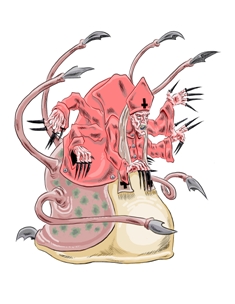
Sangre Santo is not much fun at parties. He does enjoy making deals though!
My co-GM and I made sure that there was at least one way to come out of the encounter unscathed. We also allowed for the possibility that they would figure out other ways to come out of this OK, though we could only think of the one, and we were reasonably certain they wouldn’t avail themselves of it.
As you may have already guessed – they didn’t.
Death was very much an option during this encounter. In fact Sangre Santo made it quite clear that he might kill them all quite by accident if he wasn’t careful! The sad truth is that this is one of those cases where simply killing them didn’t make sense. Quite frankly, that would have been way too passe for Sangre Santo. He didn’t want to kill them, he wanted to corrupt them. If he had to knock each and every one of them unconscious and then play “Let’s Make A Deal” with the first one to wake up over and over again until someone broke down and decided which one of their friends should be killed, so be it. After all, being an abyssal entity means that Sangre Santo has too much time on his hands. While this made a TPK unlikely, it did make it quite possible that one of the characters would be forced to sentence another one to death in order for the majority of them to live. Since it is unlikely that any player would make this choice, a successful “RESOLVE + COMPOSURE” roll would have been needed to not give in. The corrupted PC would have suffered some Morality loss and a possible derangement, the other PCs would be shocked and horrified (well, the ones that weren’t the dead one anyway), and my co-GM and I would have congratulated each other on a job well done.
Of course, failing that Sangre Santo would have eventually gotten bored again and just killed them all in the hopes that more entertainment would arrive soon.
The PCs actually caught a break here. It was down to final health points for several of the characters, and the big guy himself. Aenaiyah pulled a Hail Mary and managed to sever the connection between Sangre Santo and the mortal plane just before he managed to kill her.
This entertained him so much that he later sent her a gift!
Sangre Santo is nothing if not appreciative of a good time.
It’s important for death to be a very real threat in the campaign. The possibility of character death creates a sense of urgency and tension. The specter of death makes it clear to the players that the choices they make for their characters are important. The trick is that too much death, senseless death, and unavoidable death cause the same problems that no fear of death causes. If the players know that their characters are going to die anyway it takes away that very sense of urgency and tension – they are going to die no matter what they do!
Death needs to always be on the table, but it should always make sense, always be meaningful, and always be avoidable. If it isn’t it becomes cheapened. It becomes a certainty instead of a risk. Once the outcome is certain it just isn’t much of a game anymore.
*Let the record clearly state that the Mages and Werewolves actually opted to help this guy! (Let it also clearly state that previously the Gaurdian of the Veil handed him a fresh bottle of whiskey and pointed him toward the nearest subway tunnel.)
Hunter: The GM’s Friend
I’m finally taking some time to read through my “Hunter: The Vigil” book. I have to say, I wish I’d read this one sooner!
Yes, this is partially because I might have decided to run Hunters instead of Mages and as a result saved myself a large quantity of sanity points. Mostly though, it’s because Hunter works so well for any World of Darkness Chronicle. It’s possible for Hunters to have unique abilities based upon what Hunter conspiracies they belong to (if they belong to one at all), which allows them to be powerful enough to go up against a group of supernatural PC’s as effective antagonists. They can also wind up with the advantage of numbers if your PC’s have been running amok in your setting and causing all types of weirdness like, say, casting “Platypus Whirlwind” in the heart of mid-town Manhattan. Not that a Mage PC would ever think to do something like that, of course! I speak purely hypothetically.
No matter what skills they bring to the table however, Hunters make great antagonists because when you come right down to it, they’re just ordinary people. Once upon a time they were normal folks just looking the other way and trying not to lose their minds – to quote “A Shoggoth On The Roof“. They are the people your PC’s might have been had their own encounters with the supernatural gone only slightly differently. Wielded properly this can lead to all sorts of mayhem for your troupe.
Take for example a recent session of mine in which a Cabal of Mages and a Pack of Werewolves, who have become friends despite my best efforts to the contrary, wound up almost TPKing the entire campaign! All my co-GM and I needed to do was allow them to capture one poor, defenseless, unconscious Hunter. Some PC’s shout “Kill him! He’s a Hunter! He’d kill us if he was conscious!” Other PC’s say “But wait! He’s just a squishy mortal person, you know, like we used to be. He doesn’t know any better. One day he might become one of us!” It isn’t long before a knife gets thrown, an Acanthus Mage starts bleeding (even before she can suggest using Post Cognition to find out why he became a Hunter in the first place), sides are drawn… we haven’t gone near any of the GM’s carefully laid plans (which in this instance is fine because the GM’s got to kick back and eat chips for a change) and people are calling for initiative rolls on each other.
This, loyal readers, is what I like to call “GM Win!”
It doesn’t happen often enough.
And then there is the glorious entire section of the book that tells you how Hunters trick out their homes with booby traps. I found this section most inspirational! (Yes, that is a tear of joy sliding down my cheek as I type this.) Of course, I like to go the extra mile and dump a few dozen acid-spewing zombies on my PC’s to go along with the traps, but if you’re looking for some decent rules regarding pit traps and the like “Hunter: The Vigil” is an excellent resource! In fact, I have to admit that it’s an excellent resource for pretty much everything in the World of Darkness. It’s well organized, well edited, and clearly well thought out. As a GM or a player I highly recommend it.






 Mage Mistress